

What is the story arc in Michelle Miller’s Belonging?
Every memoir has a story arc (also called a narrative arc) or theme an author explores regarding her challenges and growth. Accordingly, she recounts events that have happened, decisions she’s made, her thoughts and feelings, and growing self-awareness to share what she’s learned about herself and life.
Examples of story arcs are of self-empowerment, our connection to spirit, recovery from addiction or trauma and not belonging or fitting in.
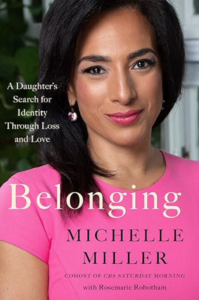 The story arc is often surmised in a memoir’s subtitle, as with CBS journalist and correspondent Michelle Miller’s Belonging: A Daughter’s Search for Identity Through Loss and Love.
In her story, Miller tells of her father, a successful Black surgeon who, even in “progressive 60s” Los Angeles, encountered racism that spurred him to political activism. (He was the doctor on call during Robert F. Kennedy Jr.’s assassination.) “The child of a clandestine affair,” she writes, her father was hesitant to tell her the identity of her mother, who surely wasn’t Black.
Feeling different and alone
Raised by her loving grandmother and a handful of other women, Miller longed for a connection to her biological mother. (She’d met the women at 9-years-old, and a few times before, but had no memory of them.) Throughout her childhood, a part of her felt motherless, abandoned, unworthy, and alone. She struggled to find a sense of belonging.
Miller’s mother was Chicana, but looked white. So peoples’ reactions to her own unique skin color was only more “evidence” she didn’t fit in.
She describes attending Howard University, an academic establishment founded for Black students, who all came to appreciate and honor their Blackness—their history, diversity, learn about the lies they were fed by our White-dominated society, make connections, and unite in solidarity.
The universal search for identity
In this milieu, Michelle begins embracing herself as a Black person and women, trusting herself, speaking her mind, facing her fears, discovering a love of journalism. As she comes into her own, there is no turning back. Her indomitable sense of self, despite the doubts, remains with me to this day.
In several ways, Miller’s story mirrors that of former Miss Deaf America Brandi Rarus’ in her memoir Finding Zoe: A Deaf Woman’s Story of Identity, Love and Adoption, for which am an IPNE (Independent Publishers of New England) Book Award Finalist. While the events in the women’s lives are different, their longings for self-acceptance and overcoming suffering are the same.
Rarus became Deaf at age five. Yet already having language and a talent for lipreading, she mostly kept hearing friends, and all throughout elementary and high school didn’t accept her Deafness and pretended she was still hearing. Like Miller, she struggled to fit in.
College, a time of discovery
When she arrived at college at NTID (National Technical Institute for the Deaf), Rarus began embracing her Deafness, as did all the other Deaf students, who, in one way or another, had experienced being Deaf as “less than.” For example, they were taught by hearing people that speaking is better than signing.
Rarus was exploring her identity as a Deaf woman in a hearing-dominated world just as Miller was exploring her identity as a Black woman in a White-dominated one. Both women longed to be self-expressed. They both even had mentors named Angie!
Indeed, there’s a scene in Belonging where, in 1989 before the presidential election, Howard University’s students come together to object to Lee Atwater, the man who architected the Willie Horton ad campaign to stoke white fear and present Democratic candidate Michael DuKakis as soft on crime, being placed on their school board.
It reminds me so of the scene in Finding Zoe where, in March of 1988, the students at Gallaudet University—known as the Harvard of Deaf Universities—closed down the school in protest in their fight for a Deaf president. Since its inception 125 years earlier—and funded by Congress—Gallaudet had never had a Deaf president.
The Deaf students actually cried out, “Howard University has a Black President and Gallaudet University must have a Deaf President now, too. The historic event known as the Deaf President Now Protest, where Rarus and hundreds of others marched to the Capitol, inspired the passing of the ADA (American Disabilities Act) changing the lives of Deaf people forever.
A powerful story arc makes the personal universal. It threads through a memoir holding it together. If, like Miller and Rarus, you have struggled with feeling different, let’s talk. I can help you turn your powerful story into an industry-standard memoir.